worldtamils

Thursday, June 18, 2009


Channel4


Fresh claims over Tamil casualties

Updated on 17 June 2009

By Jonathan Miller

A doctor working with injured and displaced Tamils in northern Sri Lanka tells Channel 4 News that there may be as many as 20,000 amputees among those who fled last month's routing of the Liberation Tigers of Tamil Eelam.


Eyewitnesses interviewed during a week-long undercover investigation for Channel 4 News, told of thousands of civilian deaths as government forces advanced on the Tigers' final stronghold.

The deaths, they said, were the result of government shelling.

The Sri Lankan president and senior government ministers have repeatedly denied causing a single civilian death in what the government had desginated a "no-fire zone."

International aid agencies believe as many as 100,000 civilians may have been trapped inside, under a fierce bombardment.

"I think every day a thousand people were killed," one of the very last to escape the tiny enclave told us. He was referring to the final two weeks of the conflict, during which the Sri Lankan government claimed not to have used heavy artillery.

"There were continuous shelling attacks," said the eyewitness. We have verified his identity as a man in a position of authority, but we are unable to reveal it.

Members of Sri Lanka's ethnic Sinhalese majority also expressed deep misgivings about the fate of the island's Tamil minority now that the Tamil Tigers have been so decisively defeated. Despite severe restrictions on access to camps for displaced civilians, evidence is emerging of maltreatment, despite a promise made by President Mahinda Rajapaksa in his "victory speech" to Sri Lanka's parliament.

Speaking in the Tamil language, the president promised equal rights for Tamils and took "personal responsibility" for protecting them.

"Our heroic forces," he said, "have sacrificed their lives to protect Tamil civilians." A senior Roman Catholic priest, who has worked with the displaced in the heavily militarised northern town of Vavuniya, said the triumphalism of Sinhalese was "very sad" to witness.

"There is no one to represent the aspirations of the Tamil community," he said. "They have a very uncertain future. It means they will live as a subjugated community, like under a foreign ruler."

One of the few senior members of the Tamil Tigers to have survived, Selvarasa Pathmanathan, its head of international relations, said yesterday that the rebels' struggle for a separate Tamil homeland would now continue from exile.

"The legitimate campaign of the Tamils to realise their right to self-determination has been brutally crushed through military aggression," said a statement, released from an unspecified location. Sri Lankans expressing concerns about the welfare and treatment of Tamil civilians -- or questioning the army's version of its final assault on the Tamil Tigers -- are branded unpatriotic, even traitorous.

Dr Wickramabahu Karunarathne, a left-wing politician and one of the few dissident voices in the Sinhalese community said: "The state media, every day, radio, papers, they classify us as traitors and they are rousing people against us."

Dr Karunaratne was the only interviewee prepared to talk openly on camera without having his face obscured and voice changed. One prominent Sinhalese journalist, Podala Jayantha, who had campaigned for greater media freedom, was abducted and severely beaten by unknown assailants, two weeks ago.

Amnesty International says that since 2006, 16 Sri Lankan journalists have been murdered, 26 assaulted, and many more detained. Foreign journalists have had their movements severely restricted and last month, our own accredited Asia Correspondent Nick Paton Walsh was deported.

Journalists and all independent observers were banned from the no-fire zone, during and after the fighting, so no independent assessments have been made of government claims not to have killed civilians. It has blamed any deaths on the rebels.

Journalists have also been unable to enter the hospital in Vavuniya, where thousands of wounded civilians are being treated. Channel 4 News successfully smuggled a small camera into Vavuniya and interviewed a Tamil doctor there.

"It is most sure that the numbers without limbs are over 20,000. Most of the injuries causing loss of limbs were from shelling," he said. The doctor alleged that conditions in the camps for displaced people around Vavuniya, are poor and that malnutrition and disease are rife.

"We were all gathered together recently by the government and we were told that if we told the figures of the sick and why people are dying to the foreign NGOs that we will be killed for doing this."

Response from the Sri Lanka government

Click on the image below to read the response in full.
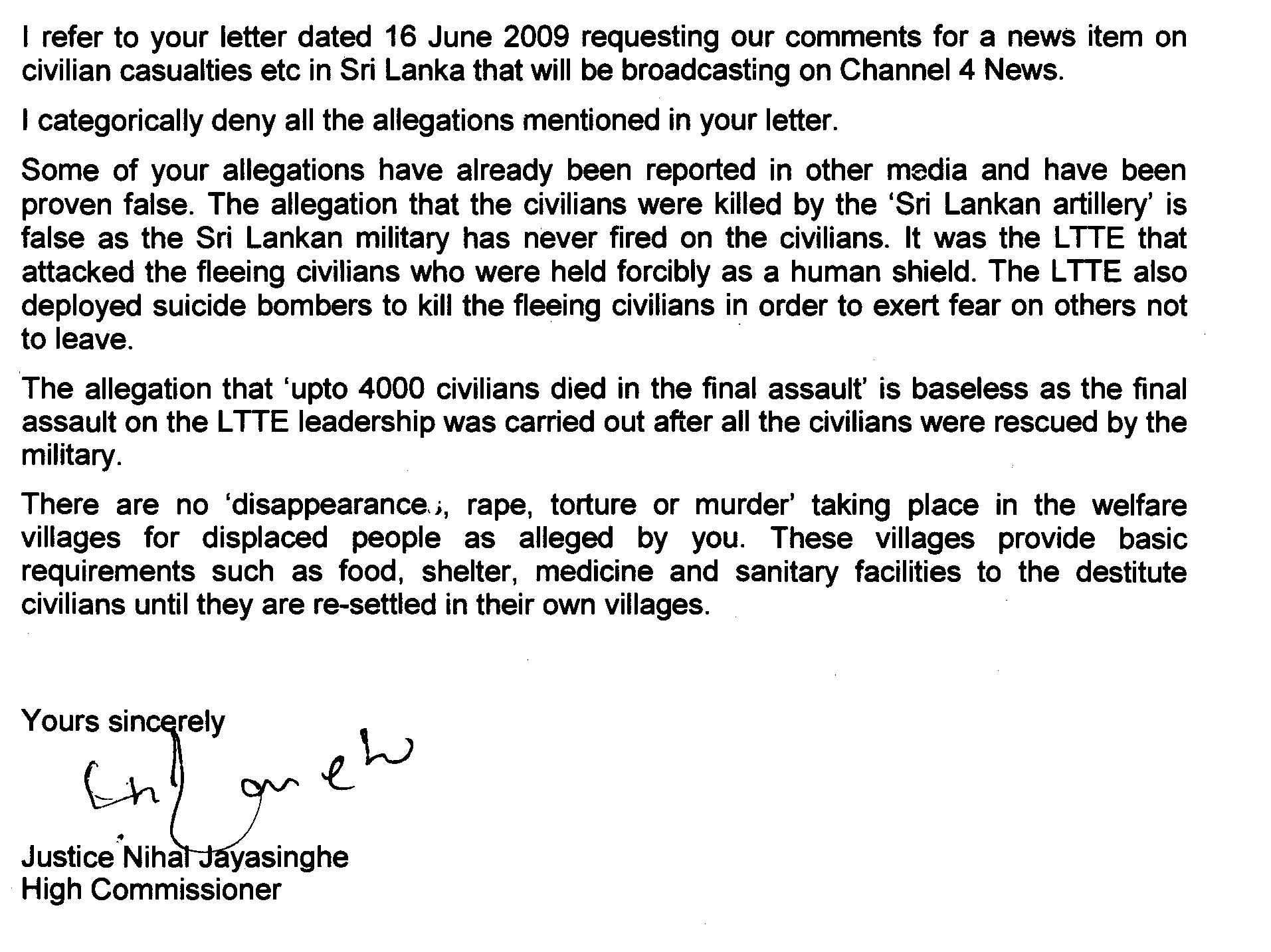

http://www.channel4.com/news/articles/world/asia_pacific/fresh+claims+over+tamil+casualties/3217257
----------------------------------------------------

Saturday, June 13, 2009

Sri Lanka after the war

Victory's rotten fruits

Jun 11th 2009
From The Economist print edition

The government’s unpleasant triumphalism is sowing the seeds of renewed conflict


Reuters

THE defeat of the Liberation Tigers of Tamil Eelam by the Sri Lankan army should be cause for almost universal celebration—whatever its manner. The foreign governments that had banned the Tigers as terrorists and from whose Tamil minorities some of the Tigers’ funds had been extorted are glad to see them beaten. So too are Sri Lanka’s Sinhalese majority, after a 26-year civil war. But Sri Lankan Tamils should also rejoice. They had borne the brunt of the Tigers’ ruthless silencing of dissenting voices, of their pressganging of children and of the bloody consequences of their refusal to countenance any achievable political settlement. Yet the government of President Mahinda Rajapaksa is making even moderate Tamils at home and overseas feel its victory as their defeat.

In the third of his big set-piece victory speeches early this month, Mr Rajapaksa asserted that the war had been fought to liberate the Tamil people. Unaccountably, he made no reference to the sufferings of Sri Lankan Tamils even though nearly 300,000 of them have been displaced from their homes and are now miserably interned in camps. The president also harked back to ancient Sinhalese martial heroes. Marking victory with plans to build stupas all over the mainly Buddhist country, and relishing songs, posters and newspaper articles hailing him as a “king”, Mr Rajapaksa seems to be cultivating the image of an elected monarch. In particular, he likes to recall Dutugemunu, a famous warrior-king of the second century BC, who defeated Elara, a Tamil usurper from India.

This foolish oratorical provocation has been matched by increasing intolerance of dissent, suspicion of many Tamils and threats against those seen as Tiger “collaborators”. The government refuses to bow to calls for an independent investigation into the final weeks of the war, in which thousands are believed to have been killed by government shelling. It blames nearly all the civilian deaths on the Tigers. But in the absence of any inquiry a decades-old culture of impunity will persist, as will Tamil grievances and a sense of injustice.

This week a shipload of relief supplies for the displaced, sent by Tamil exiles suspected of Tiger sympathies, was turned back, even though the defence ministry conceded they had no “dangerous” intentions. The process of sending the displaced people home from the camps is painfully slow, partly because of the need to de-mine and rebuild their home villages, but also because of the fixation on weeding out Tigers hiding among the civilians. One-eighth of those interned are believed to be children. In light of the Tigers’ record of deploying women and children as fighters and suicide-bombers, some caution is understandable. But little is being done to reassure moderate Tamils that the government cares for their plight. Conditions in the camps are no longer so critical, but there are too few toilets, and some have to queue five or six hours for their daily ration of water.

Meanwhile government ministers in Colombo mutter darkly about journalists and NGOs allegedly once in the Tigers’ pay. This encourages a freelance witch-hunt. On June 1st thugs abducted and beat up Poddala Jayantha, a journalist and activist. They have not been caught, but a fellow writer who alerted the police to the abduction was interrogated for hours. Scared, journalists have started to censor themselves.

No farewell to arms

Far from cashing a peace dividend by demobilising soldiers, the chief of the army has said he means to swell its ranks by 100,000, to 300,000—out of a population of just 21m. An already highly militarised country is to become even more so, with soldiers deployed everywhere to nip any reborn Tamil nationalist insurgency in the bud. In the “liberated” north local elections are to be held as early as August. Many will have to vote from the camps. Few will believe the process free or fair, seeing it, like elections in 2008 in the east, as a way of installing candidates in favour in Colombo.

Having made a strong case that it was liberating millions of its own people from the terrorist yoke, Sri Lanka’s government seems to be doing its best to make those people feel newly oppressed. That is not the way to win reconciliation. It is a prescription for renewed rebellion.

http://www.economist.com/opinion/displaystory.cfm?story_id=13829429
-------------------------------------------------------

The liberal left's war lies

Certain conflicts are simplified and championed as symbolic causes, leaving worse humanitarian cases under-reported

-------------------------------------------

Conor Foley

guardian.co.uk Tuesday 9 June 2009 08.00 BST

--------------------------------------------------------------

In George Orwell's Looking Back on the Spanish War, he wrote:

Early in life I had noticed that no event is ever correctly reported in a newspaper, but in Spain, for the first time I saw newspaper reports which did not bear any relation to the facts, not even a relationship which is implied in an ordinary lie. I saw great battles reported where there had been no fighting, and complete silence where hundreds of men had been killed. I saw troops who had fought bravely denounced as cowards and traitors, and others who had never seen a shot fired hailed as the heroes of imaginary victories; and I saw newspapers in London retelling these lies and eager intellectuals building emotional superstructures over events that never happened.

Over the past few months a number of articles have appeared comparing news coverage of the humanitarian situations in Gaza and northern Sri Lanka, and asking why the liberal left seem to care so much more about the former than the latter. Unfortunately, the articles usually then go on to ignore the situation in Sri Lanka completely while discussing a particular aspect of the Israel-Palestine conflict in great detail, which rather undermines their authors' claims to .

I was in Sri Lanka recently doing some work for a humanitarian agency. According to recent reports, up to 20,000 people were killed in the space of a few months as the army poured its firepower into an area the size of New York's Central Park where hundreds of thousands of civilians were sheltering. Those reports broadly fit with what I experienced, although the only piece I was able to write deliberately avoided any comment on the political situation.

This has been without doubt the world's worst humanitarian crisis in recent months and clearly has been under-reported, simply due to problems of gaining access. But I think there is more to it than that.

A couple of weeks ago I attended the Hay literary festival to discuss my book, The Thin Blue Line, which discusses some of the dilemmas facing contemporary humanitarianism. Also there was Luis Moreno-Ocampo, prosecutor of the International Criminal Court (ICC), in conversation with the noted human rights lawyer, Philippe Sands.

Moreno-Ocampo is seeking to bring charges of genocide against Sudan's president, Omar al-Bashir, who has responded by expelling a group of international aid agencies from the Darfur region. Large numbers of people in Darfur are completely dependent on humanitarian aid and so this could cause a catastrophe. Given that the arrest warrant cannot be enforced, there is an obvious debate to be had about whether it was worth issuing. There are also a number of questions about the timing, nature and possible political spin about this prosecution, which I have previously raised here and here.

Around 650 people died violently in Darfur last year. The region is about the size of France and this death rate is lower than in many medium-sized cities in the world today. Yet the situation continues to be described as an ongoing act of genocide in which hundreds of thousands of people are being slaughtered. This impression was reinforced at Hay by both Sands and Moreno-Ocampo. We were even asked to make a donation to a humanitarian agency on our way out, despite the fact that this aid cannot now be delivered. Darfur seems to have taken on a symbolism for one part of the liberal left in much the same way that Gaza has for another.

The first conflict I experienced first-hand was in Kosovo. Prior to Nato's intervention, Serbian forces had mounted a brutal counter-insurgency response to a campaign of terrorism by the Kosova Liberation Army. This had cost several hundred lives, it is true, yet it was clearly not the genocide which supporters of intervention claimed. Indeed, the most immediate impact was to dramatically worsen the humanitarian situation. Nevertheless, Kosovo took on a similar symbolism for an invented narrative that bore little relation to what had actually happened.

So why do the liberal left lie so often to themselves about wars?

I have worked in a dozen or so war zones and I am constantly struck by the total divergence between how the situations get debated in British politics and what I see with my own eyes. I am not a huge fan of George Orwell, but one thing he got right is that the liberal-left intelligentsia simply does not understand what war, with all its attendant horrors and hypocrisies, entails. They are prepared to accept even the most outrageous propaganda and exaggerations if it helps them to build emotional superstructures around their own myths.

In Afghanistan, for example, Nick Cohen first warned, in October 2001, that military intervention would lead to a death toll somewhere between the 25,000 who died in Dresden and the 300,000 killed at Hiroshima and Nagasaki. Six years later, in November 2007, he claimed that the Taliban was being "beaten on the battlefield" and lambasted aid workers for their "risk-averse culture".

Cohen had changed his mind about the conflict and re-fixed the facts accordingly. As Orwell observed, history gets written "not according to what happened but of what ought to have happened according to various party lines".

There is a serious debate going on about the future of humanitarian interventions, but the left have almost completely absented themselves from it, preferring to talk instead in simplistic slogans. Afghanistan is "today's Spanish civil war"; Iraq is Vietnam; Darfur is Rwanda. Where a conflict can be reduced to a spectator sport where you are "up" for one side or the other than this just about works. Where the reality is just so messy, complicated and difficult that the slogans don't fit, so the liberal left just have to ignore it.

http://www.guardian.co.uk/commentisfree/2009/jun/09/war-lies-liberal-left-humanitarian-aid
------------------------------------------------------------------------------


Surrendering Tamils were massacred by Sri Lankan army, says rights group

• Government 'authorised political killings' as war ended
• Tiger rebels accused of torture and murder of thousands
--------------------------------------------------
Gethin Chamberlain
guardian.co.uk Thursday 11 June 2009 14.39 BST
--------------------------------------------------
A devastating report into the final months of Sri Lanka's brutal civil war claims government forces carried out a politically-motivated massacre of surrendering Tamil Tiger fighters.

The investigation by a leading Sri Lankan human rights group accuses elements of the Sri Lankan army of touching "the most depraved depths of humanity".

But it also accuses the Liberation Tigers of Tamil Eelam [LTTE] of torture, murder, and the forced conscription of children, and says the rebel group was probably responsible for most of the thousands of civilian casualties in the final days of the war.

The report was issued last night by the University Teachers for Human Rights (Jaffna) group, which has spent 21 years exposing abuses by both sides in the civil war.

Its investigators uncovered evidence that LTTE fighters gunned down civilians who they believed were trying to escape and that government troops threw grenades into bunkers where they knew civilians were sheltering and used a vehicle to run over injured civilians. There are also allegations that wounded civilians may have been bulldozed into mass graves along with the dead.

The most controversial claim, however, is that the government authorised a massacre of LTTE cadres after persuading them to surrender.

Citing sources within the Sri Lankan armed forces, the report points to a "politically ordered massacre of people who wanted to surrender or surrendered".

It adds: "The army had for the most part conducted itself in a disciplined manner in trying to protect civilians. But once the command gives a signal for barbarity to be let loose, the men touch the most depraved depths of humanity."

The report comes as Amnesty International called on the Sri Lankan government to overhaul its justice system if it was to secure lasting peace.

"If communities that have been torn apart by decades of violence and impunity are to be reconciled, the Sri Lankan government should initiate internal reforms and seek international assistance to prevent ongoing violations and ensure real accountability for past abuses," said Sam Zarifi, Amnesty International's Asia-Pacific director.

In a separate report released today, Amnesty called for an international commission to investigate allegations of abuse and torture, saying that past government probes had had no impact.

Amnesty's findings were given extra weight by the Jaffna report, which found that cornered LTTE fighters were killed after being persuaded by government forces to destroy most of their weapons and to give themselves up.

"Claims of a massacre have been emanating from the security forces … these were messages from very senior officers, middle-ranking officers and personnel. They were posted in various areas. Some heard it from friends on the scene and others from the armed forces grapevine. The common substance was the same: all LTTE members who were left there were massacred, including the women and children."

The researchers also questioned the use of earth-moving equipment to dispose of the bodies inside the no-fire zone.

"Given also the fact that earth-moving equipment was used to clear the area before the president's victory announcement the following day, we need to ask if adequate care was taken to separate the dead from the injured and the dying. On the testimony of civilians there were several injured persons asking for help."

The report was equally damning about the LTTE and its supporters overseas.

The authors said the rebel group had "tortured, robbed, murdered the people, suffocated alternative voices and conscripted their children in the name of liberation".

It continued: "Even as the LTTE leaders were discussing surrender terms, they were sending out very young suicide cadres to slow down the army advance."

It said sections of the Tamil diaspora "blindly supported the LTTE's terror at home and its political articulation of people as weapons of mass suicide".

It added: "Some cadres were going to bunkers where civilians were sheltering, asking, 'So you want to run away to the army, do you?', and then opening fire at them."

The report suggested that between 1,000 and 4,000 people were killed on the final night of fighting, with the LTTE responsible for the large majority of civilian deaths.

http://www.guardian.co.uk/world/2009/jun/11/sri-lanka-tamil-tigers-civil-war

-------------------------------------------------------------

Saturday, June 06, 2009

Saturday, June 06, 2009, 08:00 Mecca time, 05:00 GMT

UN chief urges Sri Lanka inquiry

Ban Ki-moon recently visited the warzone to see how civilians were affected by the fighting [AFP]

The UN secretary-general has called for an inquiry into possible war crimes committed during Sri Lanka's offensive against Tamil Tiger separatists.

Ban Ki-moon told UN Security Council on Friday that any "credible accusations" against either the military or the Liberation Tigers of Tamil Eelam (LTTE) should be investigated.

"Whenever and wherever there are credible allegations for the violations of international humanitarian law there should be a proper investigation," Ban told said after the closed-door meeting.

"I'd like to ask the Sri Lankan government to recognise the international call for accountability and full transparency," he said.

Ban declined to elaborate on exactly how the inquiry should be done, but he urged an examination of what he said were serious allegations of violations of international humanitarian laws.

The Security Council took no action during its meetings on Sri Lanka while the military campaign was under way.

UN diplomats said that Russia, China and others on the 15-nation council believed that the war against the LTTE was a domestic issue that Sri Lankan authorities should be allowed to address on their own.

Government criticism

Human rights groups have criticised the government for what they say was a complete disregard for human life during the final months of the war by continuously using heavy artillery to shell a tiny strip of land into which the Tigers had retreated, along with hundreds of thousands of civilians.

Focus: Sri Lanka

Sri Lanka's uneasy peace
Obituary: Velupillai Prabhakaran
Q&A: Sri Lanka's civil war
The history of the Tamil Tigers
Timeline: Conflict in Sri Lanka
Riz Khan: What now for Sri Lanka's Tamils?
Calls mount for inquiry into Sri Lankan conflict
Ban and other UN officials accused the LTTE of holding the civilians hostage and using them as human shields as they fought to hold on to their sliver of coast in northeastern Sri Lanka.

The LTTE and Sri Lankan government rejected those charges.

UN officials have said it is unclear how many civilians died during the final phase of the war, which ended when the government declared victory on May 18, but some have said that at least 7,000 civilians died in the war's final stages.

John Holmes, the UN humanitarian chief, has said that several thousand civilians were killed and diplomatic sources have said the death toll was probably higher than 10,000.

By contrast, the Sri Lankan government claims that only about 3,000 to 5,000 civilians were killed.

The UN puts the number of deaths since the war began in 1983 at between 80,000 and 100,000.

'No triumphalism'

During his trip to Sri Lanka last month, Ban urged the government to improve UN humanitarian access to the refugee camps, which hold more than 300,000 people.

He told reporters that the government had told him restrictions were being eased and conditions in the camps were better.

Ban has also urged the government to ensure that it seeks reconciliation with the country's Tamil minority and that there is no "triumphalism" over the defeat of the LTTE now that the nearly 26-year war is over.

HMGS Palihakkara, Sri Lanka's ambassador to the UN, told reporters that his government was taking UN recommendations to heart, but the government has said it will not accept a full-scale war crimes investigation.

"We have initiated a process of reconciliation and fact-finding," he said.

Source: Agencies
http://english.aljazeera.net/news/asia/2009/06/20096642943521220.html
-----------------------------------------------------

telegraph.co.uk

India 'complicit' in killing of 20,000 civilians in Sri Lanka

India has been accused of complicity in the deaths of 20,000 civilians in the final stages of Sri Lanka's war against the Tamil Tigers.

Published: 6:00AM BST 01 Jun 2009
India 'complicit' in killing of 20,000 civilians in Sri Lanka
Civilians stand behind the barbed-wire perimeter fence of the Manik Farm refugee camp located on the outskirts of northern Sri Lankan town of Vavuniy Photo: REUTERS

Human rights groups have claimed India did not do enough to protect civilians in the war zone and a former commander on Indian peacekeeping forces in Sri Lanka has said India's role in the conflict was "distressing and disturbing".

"We were complicit in this last phase of the offensive when a great number of civilians were killed," Major General Ashok Mehta, who is now retired, told The Times. "Having taken a decision to go along with the campaign, we went along with it all the way and ignored what was happening on the ground."

India was part of a group led by China and Russia that blocked a proposal for a war crimes inquiry at a special session of the UN Human Rights Council last week, and instead supported a resolution praising Sri Lanka.

Brad Adams, Asia director of Human Rights Watch, said India had failed to act when the Red Cross warned of an "unimaginable humanitarian catastrophe". India "could have saved many lives if it had taken a proactive position - and it would not have affected the outcome of the war," he said.

Sam Zarifi, Asia Pacific director of Amnesty International, said: "India . . . simply chose to support the [Sri Lankan] Government's notion that it could kill as many civilians as it would take to defeat the Tigers."

General Mehta said that the Indian Government, led by the Congress Party, wanted to match China and Pakistan who had increased arms sales to Sri Lanka in the past few years. It also wanted to avenge the Tigers' assassination in 1991 of Rajiv Gandhi, the Prime Minister and late husband of Sonia Gandhi, he said.

India says that it provided Sri Lanka with non-lethal military equipment and sent officials repeatedly to persuade the Government to protect civilians. "We've consistently taken the line that the Sri Lankan Government should prevent civilian casualties," a Foreign Ministry spokesman said.


http://www.telegraph.co.uk/news/worldnews/asia/srilanka/5419206/India-complicit-in-killing-of-20000-civilians-in-Sri-Lanka.html

-----------------------------------------------------------------------------------

telegraph.co.uk

Britain sold arms to Sri Lanka during Tamil Tiger conflict

Britain sold arms to Sri Lanka worth over £13.6 million in the last three years of the conflict with the Tamil Tigers, according to reports.

Internally displaced Sri Lankan people wait behind barbed wire: Sri Lankan army accused of massacring 20,000 Tamil civilians in final assault
Hundreds of thousands of Tamil refugees are now being held in camps in Sri Lanka Photo: AFP/GETTY

Weapons including armoured vehicles, parts for machineguns and semiautomatic pistols, were sold to the Sri Lankan Government by Britain and other EU countries after 2006, despite concerns about human rights abuses.

The sales contravened the 1998 EU Code of Conduct on Arms Exports that restricts business with countries facing internal conflicts or with poor human rights records and a history of violating international law, the Times reports.

The EU called for peace talks after the collapse of the 2002 ceasefire and stated that it did not support any military solution. However, the sales still went ahead.

"The EU had an obligation not to supply these things," Malcolm Bruce, a Liberal Democrat MP who was in Sri Lanka last month told the paper. "There were too many unanswered questions. With hindsight, Britain's sales did violate the EU code of conduct."

Slovakia is the only country to record the actual delivery of the arms, confirming the shipment of 10,000 rockets worth £1.1 million.

It is not known whether British-made weapons were used during the final, bloody, five months of the war, when the UN estimate that 20,000 civilians were killed.

"I think we need answers about what these were used for," said Mike Gapes, a Labour MP and member of the Committee on Arms Export Controls.

The US also sold millions of pounds worth of military equipment to Sri Lanka, but suspended sales in early 2008 when full details of rights abuses began to emerge.

In 2008 alone, the British Government approved the sale of £4 million of equipment, including sonar detection components and military communication equipment. "We should have been sharper off the mark and so should the EU," said John Battle, a Labour MP, former Foreign and Commonwealth Office minister and now a member of the Committee on Arms Export Controls.

MPs and MEPs called for the EU's code of conduct on arms sales to be revised to increase transparency across all countries and prevent the sale of arms that could be used to violate human rights.

http://www.telegraph.co.uk/news/worldnews/asia/srilanka/5426520/Britain-sold-arms-to-Sri-Lanka-during-Tamil-Tiger-conflict.html

-------------------------------------------------------------------------

Friday, June 05, 2009

போர்க்குற்றங்களுக்கான ஆதாரங்களை மறைக்க புதிய வழிமுறைகளைக் கையாள்கிறது இலங்கை அரசு ‐ பகுதி 2 ‐ றிச்சார்ட் டிக்ஷன் ‐ தமிழில் குளோபல் தமிழ்ச் செய்திகள்:


இந்த இரத்த ஆற்றை நாம் தடுத்திருக்க முடியாதா?

பதில் ஆம் என்பது தான். ஆனால் இந்தப் போரினால் அவர்களுக்குப் பல நன்மைகள் கிடைத்துள்ளன. அதனால் இந்தப் போரை நிறுத்துவதில்லை என்று அவர்கள் தீர்மானித்தார்கள். அதேவேளை பல்லாயிரக்கணக்கான பொதுமக்களுக்குப் பாதிப்பு ஏற்பட்ட போதிலும் அதனை அதன் முடிவு வரை அனுமதிப்பது என்றும் அவர்கள் முடிவெடுத்தார்கள். இந்தியா சீனா பாகிஸ்தான் போன்ற நாடுகள் பாரம்பரியமாகவே நல்லுறவைக் கொண்டிருக்காத போதிலும் ஆச்சரியப்படத்தக்க வகையிலே நண்பர்களானர்கள். தமக்கான பங்கிறைச்சித்துண்டை கொத்திக் கொண்டு போகக் காத்திருக்கும் கழுகுகள் போல தமக்கிடையேயான உடன்பாட்டோடும் ஒரு மூர்க்கத்தனத்தோடும் காத்திருந்தார்கள்.

என்ன நடந்து கொண்டிருந்தது என்று எல்லோருக்கும் தெரியும். இழப்புக்கள் தொடர்பான புள்ளிவிபரங்களை உலகத் தலைவர்கள் கிரிக்கெட் வர்ணனை கேட்பது போல மெதுவாகக் கேட்டுக் கொண்டிருந்தார்கள். பழக்கப்பட்ட காரணத்தால் சிலர் இங்கும் அங்குமாக சில அறிக்கைகளை விட்டுக் கொண்டிருந்தார்கள்.

படுகொலைகளை நிறுத்துங்கள் என்று எவரும் உரக்கக் குரல் கொடுக்கவில்லை. அவர்களிடம் அதிகாரம் இருந்தது. ஆனால் அவர்கள் அதனைச் செய்யவில்லை.

அங்கு இடம்பெற்ற படுகொலைகளின் எண்ணிக்கையைக் கொண்டு கிரிக்கெட் ஓட்டங்களை அதன் அறிவிப்புப் பலகையில் புதுப்பிப்பது போன்று ஐநா புதுப்பித்துக் கொண்டிருந்தது. அந்த எண்ணிக்கை ஆயிரக்கணக்கைத் தாண்டிய போதும் ஐநா மௌனமாகவே இருந்தது. அவர்கள் வாயைத் திறந்து இதனைப் பற்றி எதுவும் பேசவில்லை.

ஐநாவின் சற்றலைட்டுக்கள் படங்களை எடுத்துக் கொண்டே இருந்தன. ஆனால் அந்த இரத்த ஆற்றைத் தடுத்து நிறுத்த அவை எந்தப் பிரயத்தனத்தையும் எடுக்கவில்லை. தேசங்களின் இதயங்கள் எல்லாம் கல்லாகி, உதவியேதுமின்றி சிதைந்தழிந்தன. அந்தப் பேராசைத்தனம் திருப்தி செய்யப்பட்டது.

மனித உரிமைக்காப்பாளர்களும், பெரும் ஊதியத்துடன் நியமிக்கப்பட்ட ராஜதந்திரிகளும் தங்களது காலையுணவை உண்ணுகையில் இலங்கையின் பயங்கரத்தைப் பற்றிக் கேள்வியுற்றார்கள். அவர்களுக்கு இந்தக் கதைகள் பெரும் சலிப்பூட்டுவனவாக இருந்தன. மனித உரிமை ஆய்வாளர்களும் நிபுணத்துவம் மிக்கவர்களும் அந்த உயிர்களைப் பாதுகாப்பதற்கு ஏதாவது செய்வதற்குப் பதிலாக இது தொடர்பான தங்களது ஆய்வுக்கட்டுரையை வெளியிடுவதில் கண்ணும் கருத்துமாக இருந்தார்கள். மேற்கு நாடுகள் பல தமது குரல்களை உயர்த்தினாலும் அவர்களுடைய அறிக்கைகள் இந்த அழிவுப் போக்குடைய நிகழ்ச்சித்திட்டத்தைக் கட்டுப்படுத்துமளவுக்குப் பலமானவையாக இருக்கவில்லை.

வன்னியில் இறந்து கொண்டிருந்தவர்களின் உறவினர்கள் உலகின் பிரதான தலைநகரங்களின் தெருக்களில் இறங்கினார்கள். அவர்கள் முழந்தாளில் நின்று இந்த மன்னர்களிடமும் மகாராணிகளிடமும் அழுதார்கள். அவர்கள் தங்களுடைய எதிர்ப்பைப் பல்வேறு வழிகளில் காட்டினார்கள். அவர்களது அழுகையை நாங்கள் கேட்கவில்லை. ஆனால் அவர்களை எம்மைத் தொந்தரவு செய்பவர்களாகவே நாம் பார்த்தோம். ஏனென்றால் அவர்கள் எங்களது தெருக்களைத் தடை செய்தார்கள். நாங்கள் அவர்களது அழுகையைக் காது கொடுத்துக் கேட்டிருந்தால் ஆயிரக்கணக்கான உயிர்களைக் காப்பாற்றியிருக்க முடியும்.

எங்களுடைய வானொலிகள் அவர்கள் ஏன் ஆர்ப்பாட்டம் செய்கிறார்கள் என்பதைப் பற்றிப் பேசவில்லை. ஆனால் அவர்களை எவ்வாறு அந்த வீதிகளிலிருந்து அப்புறப்படுத்துவது என்று பேசின. நாங்கள் இப்போது சந்தோசமாக இருக்கிறோம். ஏனென்றால் அங்கு எந்தத் தமிழ் ஆர்ப்பாட்டக்காரர்களும் இல்லை. பாதுகாக்க முற்பட்ட பொதுமக்களும் இறந்து பட்டு விட்டார்கள்.

இது மிகத் தெளிவானது. இந்தப் போர் பலநாடுகளின் பெரும் துணையுடன் நடத்தப்பட்டிருக்கிறது. அவர்களால் இந்த இரத்த ஆற்றைத் தடுத்துநிறுத்தும் வகையில் இலங்கை அரசை இணங்கச் செய்திருக்க முடியும். குறிப்பாக கிளர்ச்சியாளர்கள் தாங்கள் சரணடைவதாக அறிவித்த பின்னராவது.

இந்த இரத்த ஆற்றைத் தடுத்து நிறுத்தியிருக்க முடியும.; ஆனால் எவருக்கும் அதில் அக்கறை இருக்கவில்லை. ஏனென்றால் எல்லோரும் தத்தமது திட்டத்துடனேயே அங்கு சென்றிருந்தார்கள். அது முடிவுக்கு வர முன்னரே இந்தப் போரின் பங்குதாரர்கள் தமது அறுவடையைச் செய்ய ஆரம்பித்தார்கள்.

யார் இந்தப் போரால் நன்மையடைந்தார்கள்?

இந்தப்பிராந்தியத்தில் தங்களுடைய நலன்கள் பாதுகாக்கப்பட வேண்டும் என நினைக்கிற இந்தியா மற்றும் சீனா போன்ற நாடுகளின் கைப்பாவையாக இலங்கை அரசாங்கம் பயன்படுத்தப்பட்டது. இலங்கையிலிருந்து மெதுவாகத் துடைத்தழிக்கப்பட்டுக் கொண்டிருக்கும் அப்பாவித் தமிழ்மக்கள் தவிர மற்றைய ஒவ்வொருவரும் இப்போது சந்தோசமாக உள்ளார்கள்.

கடந்த 60 வருடங்களு;க்கு மேலாகவே தமிழ் மக்களைக் கொன்று வரும் சிங்களத் தீவிரவாதிகள் இப்போது மகிழ்ச்சியடைவார்கள்.

உலகின் குழம்பிய குட்டையில் சீனா மீன்பிடிக்கிறது. தனது கொலைகார ஆயுதங்களை இன்னொருவருக்கு வழங்கி அவரை பலமிக்க மனிதனாக்கியதன் மூலம் அது மீண்டும் ஒரு தடவை தனது இலக்கை அடைந்துள்ளது. அதனது கடற்டையால் பயன்படுத்துவதற்கென கட்டப்படும் துறைமுகம் உட்பட பல்வேறு கட்டுமானத்திட்டங்களை சீனா இலங்கையின் தெற்குப் பகுதியில் ஏற்கெனவே ஆரம்பித்துள்ளது.

இந்தியாவும் ஏற்கெனவே போடப்பட்ட எண்ணெய் ஆய்வுத் திட்டத்தை ஆரம்பித்;துள்ளதோடு இலங்கையின் வடகிழக்குப் பகுதியில் தனது பல்வேறு திட்டங்களை ஆரம்பிக்க தனது நிபுணர்களை அனுப்பி வைத்துள்ளது.

சீனாவும் பாகிஸ்தானும் தமது கொலைகார ஆயுதங்களை இலங்கைக்குக் கொடுத்து போரை எவ்வாறு கொண்டு செல்வது என்றும் போரை எவ்வாறு நடாத்துவது என்றும் இலங்கை அரசு;கு உதவியிருக்கிறார்கள்.

இந்தியாவின் போரை தான் இலங்கையில் நடாத்தியதாக இலங்கை ஜனாதிபதி அண்மையில் தெரிவித்திருந்தார்.

இந்தப் போரில் இந்தியாவின் கைகளில் இரத்தக்கறை படிந்துள்ளது என்று இந்தியாவின் முன்னாள் உயர் ஸ்தானிகர் ஒருவர் ஒப்புதல் வாக்குமூலம் அளித்துள்ளார். எனினும் தமிழ் மக்களின் இக்கட்டான நிலை குறித்து இந்தியா கவலைப்படவில்லை.

இலங்கையின் போர் கிளர்;ச்சிக்குழுத் தலைவரை வைத்து எதுவும் செய்வதற்கல்ல. அவருடைய உடலுக்கு அப்பால் மிகப் பெரிய கொடுக்கல் வாங்கல்கள் இடம்பெற்றிருக்கின்றன. இந்த வெற்றிப் பேச்சுக்கள் ஒன்றும் மடத்தனமானவை அல்ல. அவையெல்லாம் அந்தந்தத் தரப்புக்களால் மிக நிதானமாகச் சிந்தித்துச் செய்யப்பட்ட பேச்சுக்களே. கம்பளத்திற்குக் கீழ் ஒளிந்து கொண்டுள்ள எல்லா நச்சுப் பாம்புகளின் பேச்சுக்களே அவை.

இலங்கையின் போர்க்குற்றங்கள்:


சதாம் ஹுசைன் குர்த்ஷ் மக்களுக்கு இழைத்ததைவிட பலமடங்கான போர்க்குற்றங்களை இலங்கை அரசு தமிழ் மக்களுக்கு இழைத்துள்ளது.

வெள்ளைக் கொடியுடன் சரணடைந்த கிளர்ச்சிக்காரர்கள் படுகொலை செய்யப்பட்டுள்ளனர். காயமடைந்த பொதுமக்கள் கருணையற்ற முறையில் படுகொலை செய்யப்பட்டுள்ளார்கள்.

இலங்கைப் படையினரால் மட்டுமல்ல, இலங்கை இந்திய அரசியல்வாதிகளாலும், ஐநா அதிகாரிகளாலும் மிகக் கடுமையான போர்க்குற்றங்கள் இழைக்கப்பட்டுள்ளன.

அப்பாவிகளான ஆண்கள் பெண்கள் சிறுவர்கள் மீது தடை செய்யப்பட்ட கிளஸ்டர் மற்றும் பொஸ்பரஸ் குண்டுகள் வீசப்பட்டுள்ளன. சர்வதேச செஞ்சிலுவைச்சங்கப் பணியாளர்கள் கொல்லப்பட்டுள்ளனர். ஒரே வைத்தியசாலை பலமுறை குண்டுத் தாக்குதலுக்கு இலக்காகியுள்ளது. கட்டிடங்களும் சொத்துக்களும் மிகப் பலம்வாய்ந்த குண்டுகளினால் தகர்க்கப்பட்டுள்ளன.

அப்பாவி மக்கள் பதுங்குகுழிகளில் மாதக்கணக்காக இருக்க நிர்ப்பந்திக்கப்பட்டுள்ளனர். அவர்களுக்கு உணவும் மருந்தும் தடை செய்யப்பட்டிருக்கிறது.

இலங்கை இப்போதும் ஆதாரங்களை மறைத்துக் கொண்டிருக்கிறது:

ஐம்பதாயிரத்திற்கு மேற்பட்டோர் படுகொலை செய்யப்பட்டுள்ளனர். இதற்குப் புறம்பாக முப்பதாயிரம் பேர் காயமடைந்துள்ளனர். உண்மையான மனிதாபிமான அல்லது மீட்பு உதவிகள் எதுவும் கிடைக்கா வண்ணம் இன்னொரு மூன்று இலட்சம் பேர் இனவதை முகாம்களில் தடுத்து வைக்கப்பட்டுள்ளனர்.

இலங்கைக்குத் தெரியும் தான் மிகப் பெரிய போர்க்குற்றங்களை இழைத்துள்ளேன் என்று. அதனால் இப்போது அந்த அக்கிரமங்களை மூடி மறைக்கும் பணியில் அது இறங்கியிருக்கிறது.

போர்ப்பிராந்தியத்திலிருந்து வெளியேறிய மக்களே இந்தக் கொடுமையான போர்க்குற்றங்களின் சாட்சியாளர்களாவர். அவர்கள் தமக்கு என்ன நடந்தது என்றும் தமது அன்பிற்குரியவர்களுக்கு என்ன நடந்தது என்பதையும் கண்ணால் கண்டவர்கள். இலங்கை அரசாங்கம் ஊடகவியலாளர்களையும் மனிதநேயப் பணியாளர்களையும் சுதந்திரமாக இந்த முகாம்களுக்கு அனுமதிக்காததன் முக்கிய நோக்கமே இந்தச் சாட்சியங்களை வெளிவரவிடாமல் தடுப்பதும் அவற்றை எவ்வாறாயினும் அழித்து விடுவதனூடாக தனது போர்க்குற்றங்களை மூடி மறைப்பதும் தான்.

வன்னியில் காயமடைந்த மக்களின் உயிர்களைப் பாதுகாத்த அந்த மூன்று வைத்தியர்களுமே உண்மையான வீரர்கள் என சர்வதேச சமூகத்தால் கணிப்பிடப்படுகிறார்கள். அவர்களுடைய அந்த முயற்சியை ஊக்கப்படுத்துவதற்குப் பதிலாக இலங்கை அரசாங்கம் தனது போர்க்குற்றங்களுக்கான ஆதாரங்களை மறைப்பதற்காக அவர்களைச் சிறையில் தள்ளிப் பூட்டியுள்ளது.

இந்தப் போர் இரண்டு வாரங்களுக்கு முன்னரே முடிவடைந்து விட்டது. ஆனால் இதுவரை போர்ப்பிராந்தியங்களுக்கு ஊடகவியலாளர்களோ உதவிநிறுவனப் பணியாளர்களோ செல்ல அனுமதிக்கப்படவில்லை.

போர் முடிவடைந்த விட்டது என்றும் அங்குள்ள மக்கள் யாவரும் மீட்கப்பட்டு விட்டார்கள் என்றும் இலங்கை அரசாங்கம் அறிவித்திருக்கின்ற போதும், காயமடைந்து வீழ்ந்து கிடக்கின்ற பலர் இன்னமும் அங்கேயே கிடக்கிறார்கள். அதுமட்டுமின்றி வெளியே வர அஞ்சிய பலர் இன்னமும் பதுங்குகுழிகளுக்குள்ளேயே பதுங்கியிருக்கிறார்கள்.

புதைகுழிகள் இலங்கை அரசாங்கத்திற்கு பழைய வழிமுறைகளாகி விட்டன. போர்ப்பிராந்தியத்திற்கு இன்னமும் ஊடகவியலாளர்களோ அல்லது உதவி நிறுவனப் பணியாளர்களோ இலங்கை அரசால் அனுமதிக்கப்படவில்லை. இதற்கு மிக நீண்டகாலம் எடுக்கும். ஏனெனில் அங்கு இறந்துபட்டுக் கிடக்கும் ஆயிரக்கணக்கானவர்களின் இறந்த உடல்களை இராணுவத்தினர் அடையாளமின்றி அழித்துக் கொண்டிருக்கின்றனர்.

கிளர்ச்சித் தலைவரின் உடலைத் தகனஞ்செய்து சாம்பலை கடலில் எறிந்த விட்டதாகத் தெரிவிக்கும் இலங்கை ஆயுதப்படைகளின் தலைமையின் அண்மைய அறிவிப்பு இதேபோன்ற வழிமுறையையே அங்கு கொல்லப்பட்டுக் கிடக்கும் உடலங்களுக்கும் மேற்கொள்ளப்படும் என்பதைக் கோடி காட்டுகிறது. இலங்கைப் படைகள் அங்கு இடத்துக்கு இடம் எடுத்துச் சென்று உடல்களைத் தகனஞ் செய்யக்கூடிய உலைகளைப் பயன்படுத்தக் கூடும். இதன்மூலம் அவர்கள் எல்லாவகையான சாட்சியங்களையும் துடைத்தழித்து விடலாம்.

இது வெளிப்படையாகத் தெரிய வரக் கொஞ்சக் காலம் எடுக்கும். எவ்வளவு மக்கள் இந்தப் போரில் கொல்லப்பட்டார்கள் எனக்கணக்கெடுக்கும் போது இது தெரிய வரும்.
இவை எல்லாம் முடிந்த பிறகு நமது பிபிசி செய்தியாளர்கள் அப்பிரதேசத்திற்குச் சென்று எவ்வளவு அழகிய நீல வானமும் தங்க நிற மணலும் கொண்டது இந்தக் கடற்கரை என்று வர்ணனை செய்வார்கள்.

நன்றி: ரெலிகிராப்
நன்றி: http://www.globaltamilnews.net/tamil_news.php?nid=10323&cat=1
----------------------------------------------------------------------------------------

Monday, June 01, 2009

From
June 1, 2009

India accused of complicity in deaths of Sri Lankan Tamil Tigers

India was accused yesterday of complicity in the killing of an estimated 20,000 civilians in the last stages of Sri Lanka’s 26-year war against the Tamil Tigers.

Major-General Ashok Mehta, a former commander of Indian peacekeeping forces in Sri Lanka, said that India’s role was “distressing and disturbing”. Two international human rights groups said that India had failed to do enough to protect civilian lives.

“We were complicit in this last phase of the offensive when a great number of civilians were killed,” General Mehta, who is now retired, told The Times. “Having taken a decision to go along with the campaign, we went along with it all the way and ignored what was happening on the ground.”

Despite being home to 60 million Tamils, India has provided Sri Lanka with military equipment, training and intelligence over the past three years, diplomatic sources told The Times. More controversially, it provided unwavering diplomatic support and failed to use its influence to negotiate a ceasefire for civilians to escape the front line, they said.

India joined a bloc led by China and Russia at a special session of the UN Human Rights Council last week to thwart a proposal for a war crimes inquiry, and instead supported a resolution praising Sri Lanka. In January India voted in favour of a war crimes inquiry into Israel’s operation in the Gaza Strip, which killed an estimated 926 civilians.

General Mehta said that the Indian Government, led by the Congress Party, wanted to counterbalance China and Pakistan, its main regional rivals, which had each increased arms sales to Sri Lanka in the past few years. It also wanted to avenge the Tigers’ assassination in 1991 of Rajiv Gandhi, the Prime Minister and late husband of Sonia Gandhi, the current Congress leader, he said.

Brad Adams, Asia director of Human Rights Watch, said that neither reason justified failing to act when the Red Cross warned of an “unimaginable humanitarian catastrophe”. India “could have saved many lives if it had taken a proactive position — and it would not have affected the outcome of the war,” he said.

Sam Zarifi, Asia Pacific director of Amnesty International, said: “India . . . simply chose to support the [Sri Lankan] Government’s notion that it could kill as many civilians as it would take to defeat the Tigers.”

India says that it provided Sri Lanka with non-lethal military equipment and sent officials repeatedly to persuade the Government to protect civilians. “We’ve consistently taken the line that the Sri Lankan Government should prevent civilian casualties,” a Foreign Ministry spokesman said.

However, President Rajapaksa of Sri Lanka told NDTV: “I don’t think I got any pressure from them. They knew that I’m fighting their war.”

Mr Rajapaksa told The Week magazine that he planned to visit Delhi next month to thank Indian leaders. “India’s moral support during the war was most important,” he said.

Diplomats, human rights activists and analysts say that Delhi either did not use its full diplomatic force or, more likely, gave Colombo carte blanche to finish the war. India’s only real concerns, they said, were that the conflict should not create a flood of refugees to India. Some raised questions about Vijay Nambiar, a former Indian diplomat, who is chief of staff to Ban Ki Moon, the UN Secretary-General. The Times revealed last week that Mr Nambiar knew about but chose not to make public the UN’s estimate that 20,000 civilians had been killed, mostly by army shelling.

http://www.timesonline.co.uk/tol/news/world/asia/article6401557.ece

--------------------------------------------------------------------------------


From
June 1, 2009

Sri Lanka's crucial role in Indian Ocean power struggle

For a tiny, teardrop-shaped fragment in the Indian Ocean, Sri Lanka punches far above its weight. Its location off the southeastern coast of India may have put it right in the line of the 2004 tsunami, but it also puts it in pole position to exploit the growing geopolitical struggle unfolding in the Indian Ocean.

China’s role in the Sri Lankan civil war is well known. Its deal to build a major port at Hambantota in southern Sri Lanka is part of a regional strategy to create a “string of pearls” of friendly harbours in Pakistan, Bangladesh and Burma, along key shipping routes through the Indian Ocean. Less well known is India’s involvement in this and other deals. It was Delhi, not Beijing, that Sri Lanka first approached over the Hambantota deal. But having no need of a port so close to home India declined.

China’s entry into Sri Lanka has put India in an awkward position. Should it refuse any of Sri Lanka’s wishes, like weaponry and training, it knows that Beijing will be the next number Colombo calls. Any pressure India might try to exert on Sri Lanka is cancelled out by Chinese acquiescence, and — worse still for India — Pakistan’s acquiescence.

Pakistan has been selling arms to Sri Lanka with China’s encouragement throughout the last stages of the civil war. Hence the bizarre partnership of India, China and Pakistan on the supporting side of Sri Lanka’s self-adulating resolution at the UN Human Rights Council.


Next month, for the first time, Sri Lanka will attend the Shanghai Co-operation Council as a dialogue partner, a blessing bestowed by Russia and China in recognition of its importance in the new Indian Ocean great game.

Russia, which continues to growl over Nato expansion in Eastern Europe, is also observing keenly any activity in the Indian Ocean. Already Nato has encroached up to the Persian Gulf. In October 2007 it conducted its first ever naval exercises in the Indian Ocean, part of an American strategy to establish Nato’s presence in this crucial region. Russia, Iran — and even China — fear Nato’s expanding alliance with Pakistan will give it a foothold in the region.

Despite Delhi’s friendly relations with the West, India is desperate not to allow Pakistan to gain any more influence there.

Sri Lanka’s prime location in prime maritime real estate has elevated it to the jewel in the crown of the new Indian Ocean paradigm.

http://www.timesonline.co.uk/tol/news/world/asia/article6401262.ece

--------------------------------------------------------------------------------

guardian.co.uk

Call to free British medic held in Sri Lanka war zone

Family urges Sri Lanka to release Damilvany Gnanakumar, who treated victims of conflict, from detention camp

Damilvany Gnanakumar

Damilvany Gnanakumar, who was detained a fortnight ago, had been working in temporary hospitals in Sri Lanka's no-fire zone. Photograph: Gethin Chamberlain

A British woman who was working at a hospital helping victims of Sri Lanka's civil war has been interned in one of the island's detention camps, prompting her family to plead for urgent diplomatic help to secure her immediate release.

Speaking to the Guardian, relatives of Damilvany Gnanakumar – known as Vany – said that she was detained a fortnight ago as the Sri Lankan army moved in to finish off the remnants of the Tamil Tiger rebels after a military onslaught that left thousands dead and sent many more fleeing for their lives.

The British passport holder, who has a background in biomedical science, called the family home in Chingford, Essex, on 19 May, to beg for help.

"She said: 'I'm in this camp, you have to get me out of here,' but then the phone went dead," said her sister, Subha Mohanathas, 29, yesterday. She said that her mother, Lathaa, 45, was desperately worried, but she believed that her sister would pull through.

"Vany is one of the strongest people, she can do whatever she likes because she is not really frightened of anything.

"I just want my sister back with me as soon as possible. My mum is crying and we need her back. We didn't have anything to do with the war."

Gnanakumar had spent the last few months working in temporary hospitals in the no-fire zone, where doctors have struggled to save the lives of civilians injured during intense fighting.

Diplomatic efforts to secure her release have so far been unsuccessful and last night her family appealed to the Sri Lankan president, Mahinda Rajapaksa, to allow her to return to the UK.

She is being held in the Menik Farm camps outside the town of Vavuniya, a sprawling, sweltering expanse of tents across hundreds of acres of barren scrubland.

Gnanakumar's family arrived in the UK as refugees from Jaffna, in Sri Lanka, in November 1994. She married in 2003, but the relationship was troubled and in February 2008 she returned to Sri Lanka without telling anyone she was leaving.

The family said that Gnanakumar had been staying in Mullivaykkal - the scene of some of the heaviest fighting - and had called in January to say that she had been caught up in the conflict and was unable to leave. On 12 May they saw her on a Tamil television programme working in a hospital.

"We had not heard anything from her until then, we didn't know whether she was still alive, whether something had happened to her," said Mohanthas.

Her father, Kandasamy Kumaran, 51, who has written to his MP, Iain Duncan Smith, appealing for help, said she had come into contact with some doctors and had said she was willing to help because of her background in biomedical science. She had also had training and work experience at a British hospital, he said.

"She was recruited by the Mullivaykkal hospital to help and nurse the injured. In fact, I saw her [on television] assisting and looking after the wounded patients," he said.

Gnanukumar's uncle, Navaratnasamy Naguleswaran, said the family had decided to make a public appeal because they were concerned that attempts to secure her release through the Foreign Office had so far proven unsuccessful.

He said the family had received a call last Friday from the Foreign Office to say that it was seeking her release, but that information since then had been sparse.

In an email to the family, the Foreign Office said that staff from the British high commission in Colombo had been in touch with the Sri Lankan ministry of defence, via a military liaison officer, to arrange a phone call between Gnanakumar and her family in the UK and "to expedite her early release".

The email said that the liaison officer would send instructions to his colleagues in Vavuniya to initiate the screening process of Gnanakumar and that once that was complete, "they will be able to take a decision on her release". A British high commission spokesman said: "We are in discussions with the government of Sri Lanka and are actively seeking her release and return to the UK."

Mahinda Samarasinghe, the Sri Lankan human rights minister, was unavailable for comment last night.

But last week, he insisted that the Sri Lankan government was determined to return those held in the camps to their homes at the earliest possible opportunity.

"These are our people and we are going to ensure that they are resettled," he said.

But he added that the government needed time to screen those being held in the camps to establish whether or not they were members of the Liberation Tigers of Tamil Eelam (LTTE). An estimated 270,000 people are being held in camps in the north of Sri Lanka. The government says that it has so far identified more than 9,000 former LTTE members.

In an exclusive interview with the Guardian from the no-fire zone on 13 May, Gnanakumar described the horrors of the final days of the 26-year war. A shell had exploded at the hospital where she was working, killing 47 people.

"This is really a disaster. I don't know really how to explain it. At the moment, it is like hell," she said at the time. "For us, shell bombing is just a normal thing now. It is like an everyday routine. We have reached a point where it's like death is not a problem at all."

The Sri Lankan government maintains that civilian casualties were the result of attacks by the LTTE designed to generate adverse publicity for the military. But the UN has described the civilian toll as "unacceptably high". Estimates for the death toll this year alone range from 8,000 to more than double that number.

http://www.guardian.co.uk/world/2009/may/30/sri-lanka-british-medic-detained

--------------------------------------------------------------------------------------------